The self-proclaimed grand marshal of the yokai who wanders into houses
Nurarihyon
"Grand marshal of the yokai" — a title only recently applied to him. His true identity is still unknown, yet every evening, in the busy hush before dinner, he lets himself into someone's home and sips his tea with a perfectly untroubled face.
Overview
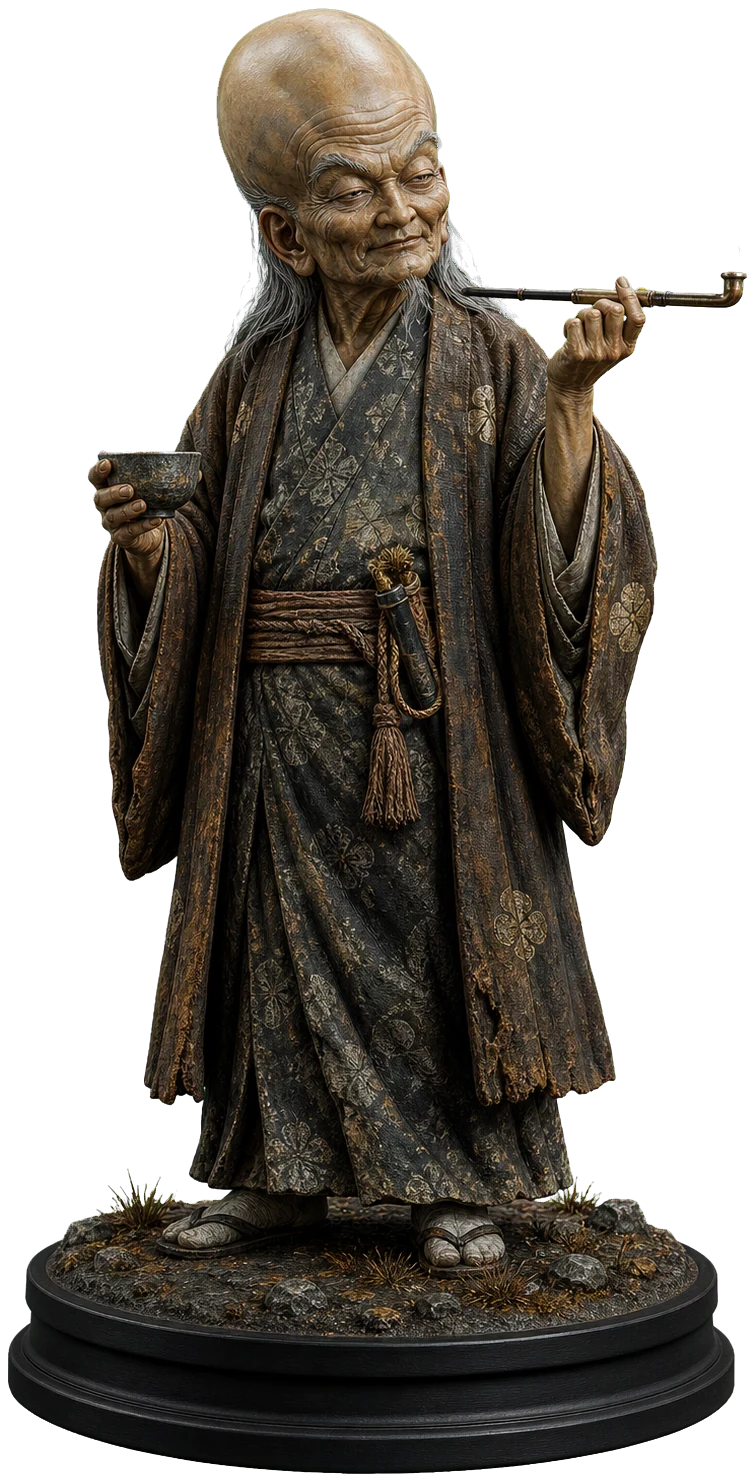
In the evening rush, Nurarihyon slips uninvited into other people's homes to drink tea and smoke a pipe. He is also known by the epithet "grand marshal of the yokai."
Encounter
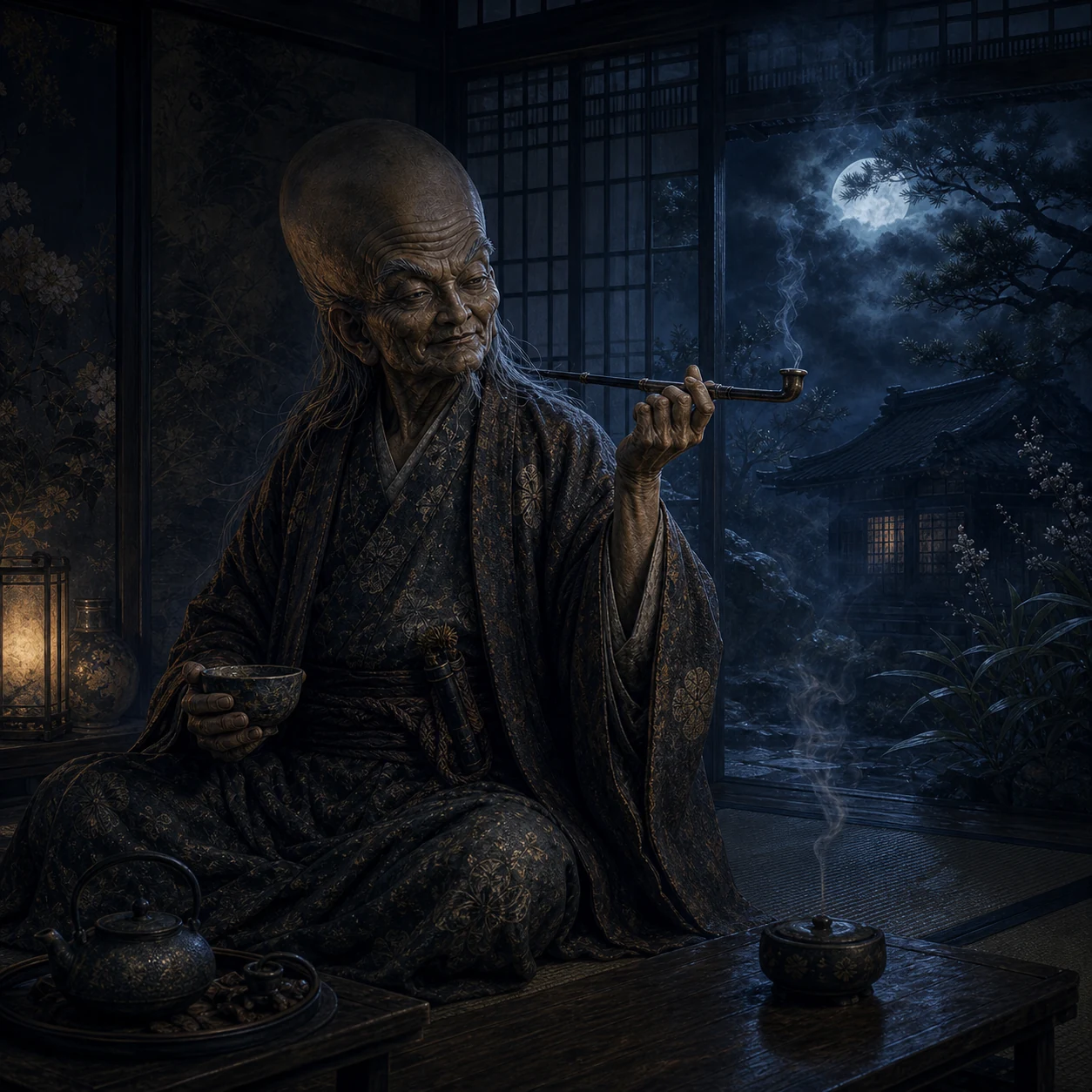
He appears at dusk, timing his visit to the moment a household is too busy with chores and dinner preparations to notice. He lets himself into the entryway or parlor, calmly sips tea and puffs at a pipe, and when questioned or challenged, gives no straight answer and slips free of any attempt to catch him, vanishing before anyone realizes it. Along the Seto Inland Sea coast, he is also sighted as a round, ball-like apparition bobbing on the water, sinking and resurfacing whenever a fisherman tries to grab it.
Lore
Nurarihyon appears by name in Edo-period yokai picture scrolls and dictionaries, depicted as a large-headed old man stepping down from a palanquin in Toriyama Sekien's Gazu Hyakki Yagyo (1776) and, earlier still, in Sawaki Suushi's Hyakkai Zukan (1737); neither work offers explanatory text beyond the name and image. The name itself is older, first attested as a descriptive turn of phrase rather than a yokai's name in Ihara Saikaku's haikai verse Saikaku Gohyakuin (1679), and later recorded around 1797 in the dictionary Rigen Shuran as "the name of an elusive imaginary monster." Okayama Prefecture preserves a separate tradition of a round, ball-shaped Nurarihyon bobbing at sea, distinct from the old-man figure, while the folklorist Sugae Masumi listed the name among a Hyakki Yagyo procession in Akita in his Yuki no Dewaji (1814). The now-famous image of Nurarihyon sneaking into houses at dusk and claiming to be the "grand marshal of the yokai" traces to a caption the folklorist Fujisawa Morihiko attached to Sekien's picture in the early Showa era; researchers Murakami Kenji and Tada Katsumi have both identified this personality as a later invention with no basis in pre-Edo sources, one that television's GeGeGe no Kitaro (third series, from 1985) then fixed in popular culture.
Traits
He is a large-headed old man dressed like a well-off household master, appearing at dusk to slip into other people's homes while everyone is too busy to notice, behaving as though the house were his own. Confronted, he shows no alarm, sipping tea and smoking his pipe with perfect composure; pressed to explain himself, he never reveals his true nature, and any attempt to seize him only finds him sliding free, gone before anyone can react. He favors the great houses of the wealthy, skillfully finding the moment a master's guard is down, rarely staying long before quietly moving on elsewhere. Along part of the Seto Inland Sea coast he is also known in a ball-shaped form bobbing on the water, slipping from a fisherman's grasp again and again as it sinks and resurfaces, toying with anyone who tries to catch it. What connects this sea-going form to the one who wanders from house to house on land remains unclear, and his true nature is still wrapped in mystery.
The name of an imaginary monster as elusive as a catfish.
Rigen Shuran